DoorStep Dental brings registered dental hygienists, usually a team of two, to your long-term care or retirement home. We clean teeth and dentures at the bedside, in the resident’s suite or in a clinic room you set aside. There is no cost to the home. Each resident is billed on their own, and we bill the Canadian Dental Care Plan (CDCP) directly.
- Registered dental hygienists
- CDCP direct billing
- CDHO and IPAC standards
- 7 days a week, including evenings
- New Business of the Year 2026
Request a Visit
Tell us a little about your home or your parent. We’ll call you to plan the visit.
Your information is private and used only to plan care.
Can a Dental Hygienist Come to Your Long-Term Care or Retirement Home?
Yes. Registered dental hygienists (RDHs) can provide cleanings, gum care, fluoride and denture care inside your home. We bring a portable dental chair, a light, suction and sterilized instruments. You don’t need a dentist referral. Care happens where the resident already lives, so nobody has to arrange transport or an escort. Here is how mobile dental hygiene compares with in-clinic cleanings.
We provide dental hygiene for long-term care and retirement homes, and for assisted living. Most visits happen in the resident’s room. For larger groups, we run clinic days in a quiet room on site.
Do Ontario Long-Term Care Homes Have to Provide Dental Care?
Ontario’s long-term care rules expect homes to support residents’ daily mouth care and their access to dental care. We help your team meet that standard. Every visit ends with written notes for the resident’s chart.
Why Mouth Care Matters for Residents
Pneumonia is the leading cause of death in long-term care. About 1 in 10 of those deaths may be preventable with better mouth care (McMaster Optimal Aging Portal, 2014). Plaque bacteria can be breathed into the lungs and cause pneumonia, especially in residents with swallowing problems.
Daily brushing between visits makes a big difference too, and our guide to senior oral care at home covers the basics. Nursing homes that improved daily mouth care had 31% fewer pneumonia cases after a year (Zimmerman et al., JAMA Network Open, 2020).
Most residents don’t get the care they need. In one Canadian study, only 25% of long-term care residents received regular dental care. Among residents with lower dentures, 59% had dentures that didn’t stay in place (Matthews et al., Journal of the Canadian Dental Association, 2012).
In our work, the same problems come up again and again. We see heavy tartar behind the lower front teeth, decay along the roots, and dry mouth from medications. We also find sore spots under dentures that nobody had noticed.
Signs a Resident Needs a Hygienist
Staff and families are often the first to notice. Book a visit if a resident:
- Refuses food, eats only soft foods or chews on one side
- Leaves their denture out, or pulls at it
- Has bleeding, red or swollen gums
- Has bad breath that brushing doesn’t fix
- Has loose or broken teeth
- Becomes agitated at mealtimes or during mouth care, which can signal pain
What We Do During an On-Site Visit
Every visit follows the same routine, so staff know what to expect:
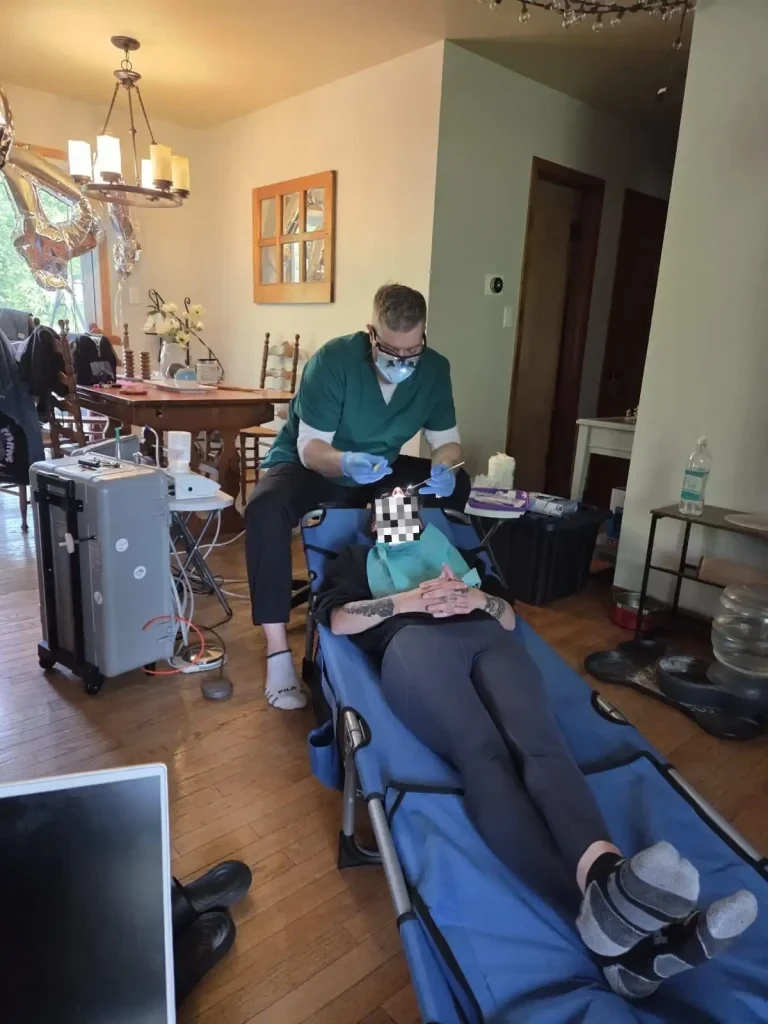
- Chart and medication review. We check the care plan, medications, allergies and any heart or joint conditions.
- Oral assessment and oral cancer screening. We check teeth, gums, tongue, cheeks and the roof of the mouth at every visit, the same as in our in-home oral health assessments for seniors.
- Cleaning. We remove plaque and tartar with hand scalers, then polish.
- Protection. We apply fluoride varnish to fight root decay, and desensitizer where needed.
- Notes and follow-up. We leave chart notes and a simple mouth-care plan for PSWs. If something needs a dentist or denturist, we flag it and help with the referral.
Bedside and Suite Visits
Bedside visits suit residents who are bed-bound, tire quickly or live with dementia. Learn more about our care for residents with limited mobility. We raise the head of the bed and use suction to protect the airway. We can also work with a resident sitting in a wheelchair or recliner.
Clinic Days in a Room at Your Home
For homes with many residents, we set up a portable chair in a quiet room. Staff bring residents to us on a schedule. We see up to 7 residents per clinic day. Many homes book clinic days every three or six months.
How We Care for Residents with Dementia
We plan dementia visits around the resident, not the clock. A rushed visit leads to refusal, so we slow down.
Here is what works for us at the bedside:
- We approach from the front at eye level, say our name and explain each step in a few words.
- We keep sessions short. If a resident tires, we stop and come back later that day or on another visit.
- We invite a familiar PSW or family member to stay and hold the resident’s hand.
- We choose the best time of day. Many residents are calmer in the morning.
- We watch for pain cues such as grimacing, pulling away or refusing food.
We never force care. If a resident refuses, we note it and try again another day.
Have residents who refuse mouth care? Call (226) 507-2464. We’ll plan a visit that works with your care team.
Who Gives Consent for a Resident’s Dental Care?
A resident who can understand the treatment gives their own consent. If they can’t, their substitute decision-maker (SDM) decides. Ontario’s Health Care Consent Act sets the order. It is usually a power of attorney for personal care or the closest family member.
We send consent forms before the first visit. We confirm consent at every visit, and we explain any new treatment before we start.
What Your Home Provides on Visit Day
Our set-up is small. We need:
- A power outlet near the bed or chair, or a quiet room for clinic days
- One staff contact for the day
- A list of residents booked, with current medication lists
- Signed consent forms
We follow College of Dental Hygienists of Ontario (CDHO) standards and Infection Prevention and Control (IPAC) rules. Read more about how we keep mobile dental hygiene safe. We follow your screening and outbreak rules, and reschedule if a unit is closed. We also carry professional liability insurance.
Who Pays for Dental Hygiene in Long-Term Care?
The home pays nothing, and there is no minimum number of residents. Each resident is billed on their own. OHIP doesn’t cover routine dental cleanings, so most residents use one of these:
- Canadian Dental Care Plan (CDCP). We are a registered CDCP provider and bill the plan directly. Seniors may qualify with an adjusted family net income under $90,000 and no dental insurance (Ontario Dental Association).
- Private insurance. We help with claim forms and predeterminations.
- Private payment. Families pay after the visit. We accept all modes of payment, including cash, credit cards, Mastercard, e-Transfer and more.
Coverage matters here. Only 41.2% of Canadian seniors have private dental insurance (Statistics Canada, 2024). Low-income seniors may also qualify for the Ontario Seniors Dental Care Program through their local public health unit.
How Often Should Residents Have a Dental Cleaning?
Most residents do well with a cleaning every three to six months. Residents with gum disease, dry mouth or who can’t brush on their own often need care every three months. After the first visit, we recommend a schedule for each resident and add it to their care plan. Long gaps add up quickly, as we explain in what happens when seniors skip dental cleanings.
For Families: Booking a Cleaning for One Resident
You don’t need the home to sign up for a program. Call us with your parent’s name, residence and room number. We’ll check their coverage and confirm consent with you.
Then we book a time with the nursing staff, around meals and medications. After the visit, we send you a short summary of what we found and what comes next. If your parent still lives at home, see our mobile dental hygiene services for seniors.
Who Provides the Care
Registered dental hygienists come to you, usually as a team of two. Every hygienist on our team is registered with the College of Dental Hygienists of Ontario.
DoorStep Dental was named New Business of the Year 2026 by the Greater Kingston Chamber of Commerce. We also received the Community Impact Award 2026 at the Startup Growth Awards.
Hear From One of Our Clients
Areas We Serve
We visit long-term care homes, retirement residences and assisted living across Ontario. As a mobile dental hygienist team, we serve care homes in:
- Eastern Ontario: Kingston, Gananoque, Sydenham, Picton, Belleville, Brockville, Cornwall and Ottawa
- Greater Toronto Area: Toronto, Etobicoke, Brampton and Mississauga
- Durham Region: Whitby, Oshawa and Ajax
- Also serving: Halton Region
Winter is when residents miss the most care. From December to March, icy roads make clinic trips risky. On-site visits keep cleanings on schedule all year.
Bring a Dental Hygienist to Your Residence
Dental hygiene for long-term care and retirement homes keeps residents eating well and free of mouth pain. It also takes transport, escorts and missed appointments off your team’s plate.
Call (226) 507-2464 or use the form at the top of this page. For other organizations, such as shelters or workplaces, see our on-site dental hygiene for organizations page.
Frequently Asked Questions
Do you clean dentures?
Yes. We clean full and partial dentures, check the fit and look for sores. If a denture needs a reline or repair, we refer you to a denturist.
What happens if a resident needs a filling or an extraction?
A hygienist can’t do fillings or extractions. We note what we found in the chart and tell the family or nurse. Then we help arrange a referral to a dentist.
Do you visit during an outbreak?
We follow your home’s outbreak rules and public health direction. If a unit is closed, we reschedule those residents. Open units can usually go ahead.
Do you visit assisted living and retirement residences too?
Yes. We visit long-term care homes, retirement residences and assisted living. Residents in retirement homes can book on their own or through family.
How soon can you start?
We can usually hold a first clinic day within 2 weeks. Family bookings for one resident are often faster.
Do you work evenings and weekends?
Yes. We book visits 7 days a week, including evenings and weekends.